The 10 Planets in Astrology: Complete Guide to Planetary Meanings
Master the core meanings of all 10 astrology planets. Learn how each planet shapes personality, life areas, and chart interpretation for beginners.
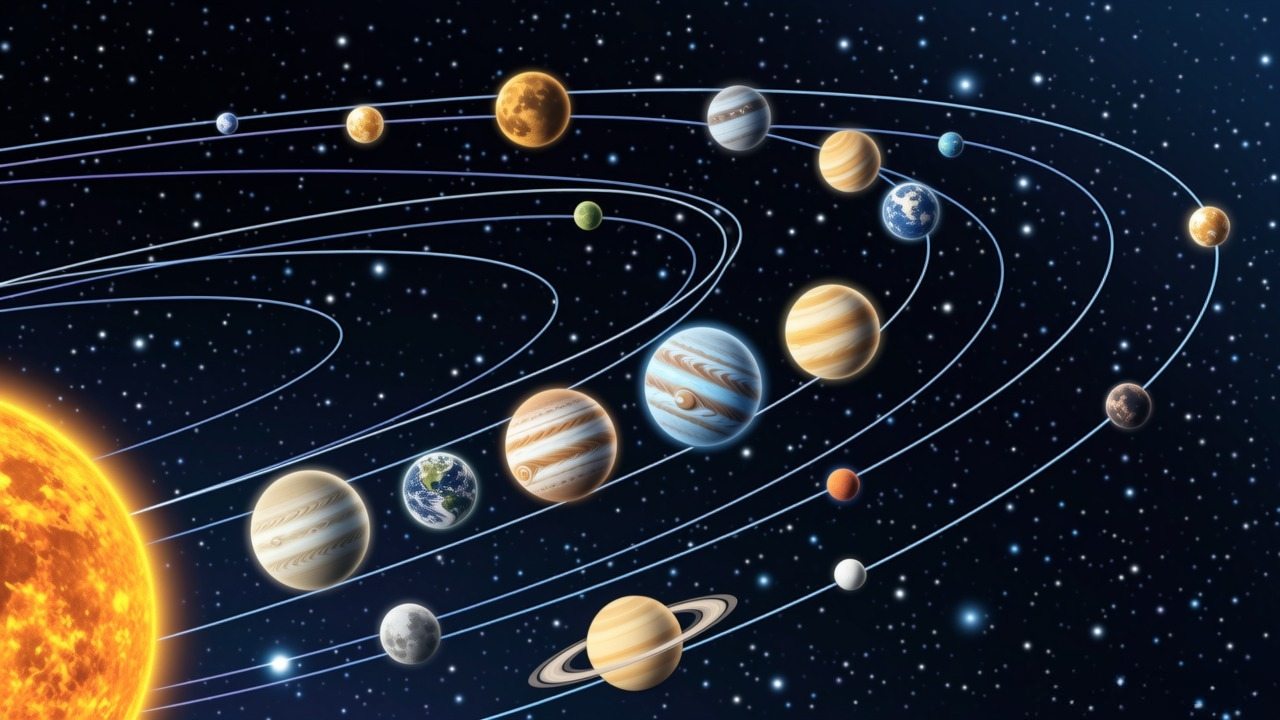
Understanding the planets forms the foundation of astrological interpretation. Each planet represents a specific archetype—a fundamental energy that manifests differently depending on its zodiac sign, house position, and aspects to other planets. When you look at your birth chart, you're essentially seeing a snapshot of how these ten planetary energies were configured at your moment of birth.
Traditional astrology classifies planets into three main categories: personal, social, and transpersonal. This framework helps us understand how each planet operates in our lives, from our most intimate personality traits to broader generational influences.
The Personal Planets: Your Core Identity
The personal planets—Sun, Moon, Mercury, Venus, and Mars—move quickly through the zodiac, spending relatively short periods in each sign. These planets describe your fundamental personality, how you think, feel, love, and take action. They form the core of who you are as an individual.
The Sun: Your Essential Self
The Sun represents your core identity, vitality, and life purpose. In traditional astrology, the Sun is considered the most important planet in the chart—the "luminary" that illuminates your fundamental nature. Your Sun sign describes what you're here to become, your essential character, and how you express your creative energy.
When the Sun is strong in a chart (well-placed in its own sign of Leo or in the 1st house), it often indicates someone with strong self-awareness and natural leadership abilities. A challenged Sun (in difficult aspect to Saturn, for example) might suggest struggles with confidence or difficulty expressing one's true nature.
Key themes: Core identity, vitality, creativity, self-expression, life purpose, father figures, authority
The Moon: Your Emotional Nature
The Moon governs your emotional world, instincts, and unconscious patterns. While the Sun represents your conscious self, the Moon describes your inner world—how you process feelings, what you need to feel secure, and your deepest habits. In traditional astrology, the Moon is the second luminary and represents the receptive, feminine principle.
Your Moon sign reveals your emotional comfort zone and how you nurture others. A well-aspected Moon often indicates emotional intelligence and natural caring abilities, while a challenged Moon might suggest moodiness or difficulty with emotional security.
Key themes: Emotions, instincts, security, home, mother figures, habits, unconscious patterns
Mercury: Your Mind and Communication
Mercury rules thinking, communication, and how you process information. This planet determines your mental style—whether you think quickly or deliberately, how you express ideas, and how you learn. In traditional astrology, Mercury is considered neutral, taking on the qualities of whatever planet it aspects most closely.
Mercury's position shows how you communicate in daily life, from conversations to written expression. When Mercury is retrograde in a birth chart, it often indicates someone who thinks deeply before speaking or has a reflective mental process.
Key themes: Communication, thinking, learning, reasoning, transportation, technology, siblings
Venus: Your Values and Relationships
Venus governs love, beauty, values, and attraction. This planet describes what you find pleasing, how you relate to others, and your approach to harmony and aesthetics. In traditional astrology, Venus represents the principle of attraction and union.
Your Venus sign reveals your relationship style and what you value in partnerships. It also indicates your artistic tastes and how you create beauty in your life. A strong Venus often suggests social grace and an appreciation for life's pleasures.
Key themes: Love, relationships, beauty, values, money, art, harmony, pleasure
Mars: Your Drive and Action
Mars represents energy, desire, and assertion. This planet shows how you take initiative, pursue goals, and express anger or passion. In traditional astrology, Mars is the "lesser malefic," representing necessary conflict and the energy required to overcome obstacles.
Your Mars sign reveals your approach to competition, physical energy levels, and how you handle conflict. A well-placed Mars indicates strong initiative and courage, while a challenged Mars might suggest impulsivity or difficulty with anger.
Key themes: Action, desire, energy, assertion, competition, courage, conflict
Personal Planets Comparison
| Planet | Zodiac Period | Core Function | Key Questions |
|---|---|---|---|
| Sun | 1 month | Identity & Purpose | Who am I at my core? What is my life purpose? |
| Moon | 2.5 days | Emotions & Security | What do I need to feel secure? How do I process feelings? |
| Mercury | 3-4 weeks | Mind & Communication | How do I think and communicate? What is my learning style? |
| Venus | 4-5 weeks | Values & Relationships | What do I love and value? How do I relate to others? |
| Mars | 6-7 weeks | Action & Desire | How do I take action? What drives me? |
The Social Planets: Your Place in Society
The social planets—Jupiter and Saturn—move more slowly through the zodiac, spending about a year in each sign. These planets describe how you relate to society, your growth opportunities, and your responsibilities.
Jupiter: Expansion and Growth
Jupiter represents expansion, growth, wisdom, and opportunity. In traditional astrology, Jupiter is the "greater benefic," bringing optimism and good fortune wherever it appears in your chart. Jupiter shows where you naturally attract abundance and where you seek meaning beyond everyday concerns.
Your Jupiter sign reveals your approach to learning, travel, and philosophical exploration. A strong Jupiter often indicates natural optimism and the ability to see the bigger picture, while a challenged Jupiter might suggest over-optimism or difficulty with boundaries.
Key themes: Expansion, growth, wisdom, opportunity, faith, travel, higher education
Saturn: Structure and Responsibility
Saturn represents structure, discipline, and life lessons. Known as the "greater malefic" in traditional astrology, Saturn creates necessary limitations that help us build lasting achievements. Saturn shows where you face challenges that ultimately lead to maturity and wisdom.
Your Saturn sign reveals your approach to responsibility, authority, and long-term goals. A well-aspected Saturn indicates discipline and reliability, while a challenged Saturn might suggest fear of limitation or difficulty with authority figures.
Key themes: Structure, discipline, responsibility, limitations, time, maturity, authority
Social Planets Comparison
| Planet | Zodiac Period | Core Function | Growth Area |
|---|---|---|---|
| Jupiter | 1 year | Expansion & Opportunity | Where do I find meaning and growth? What comes naturally? |
| Saturn | 2.5 years | Structure & Responsibility | Where do I need to develop discipline? What challenges build character? |
The Transpersonal Planets: Generational Influences
The transpersonal planets—Uranus, Neptune, and Pluto—move very slowly through the zodiac, spending years or even decades in each sign. These planets describe generational influences and profound psychological transformations.
Uranus: Innovation and Revolution
Uranus represents innovation, revolution, and sudden change. Discovered in 1781, Uranus brought astrological correspondence to the Age of Enlightenment and revolutionary thinking. This planet breaks down existing structures to make way for progress.
Your Uranus sign (shared with your generation) reveals how you approach change and innovation. Uranus aspects to personal planets in your chart show where you express individuality and embrace the unconventional.
Key themes: Innovation, revolution, freedom, individuality, sudden change, technology
Neptune: Dreams and Illusion
Neptune governs dreams, spirituality, and illusion. Discovered in 1846, Neptune corresponds with the Romantic movement and the rise of photography—both dealing with idealization and altered perception. Neptune dissolves boundaries between self and other, creating connection but also potential confusion.
Your Neptune sign describes your generational approach to spirituality and creativity. Neptune's aspects show where you experience compassion, inspiration, or potential deception.
Key themes: Dreams, spirituality, illusion, compassion, creativity, mysticism
Pluto: Transformation and Power
Pluto represents transformation, power, and rebirth. Discovered in 1930, Pluto's discovery coincided with the rise of psychology and nuclear power—both dealing with fundamental forces beneath the surface. Pluto destroys to regenerate, bringing profound transformation.
Your Pluto sign indicates your generation's approach to power and transformation. Pluto's aspects in your personal chart show where you experience deep psychological change and confront power dynamics.
Key themes: Transformation, power, rebirth, psychology, control, regeneration
Transpersonal Planets Timeline
| Planet | Discovery | Zodiac Period | Generational Focus |
|---|---|---|---|
| Uranus | 1781 | 7 years per sign | Innovation & Individuality |
| Neptune | 1846 | 14 years per sign | Dreams & Spirituality |
| Pluto | 1930 | 14-30 years per sign | Transformation & Power |
Planetary Condition: Essential Dignities
In traditional astrology, planets operate differently depending on their condition in your chart. The concept of "essential dignity" describes how comfortable a planet is in its zodiac sign position. A planet in its own sign (like Mars in Aries) operates strongly and naturally, while a planet in its detriment or fall operates with more difficulty.
Planetary Conditions:
- Domicile/Rulership: Planet in its own sign (strong, natural expression)
- Exaltation: Planet in a sign where it's especially honored (enhanced expression)
- Detriment: Planet in the opposite sign of its rulership (challenged expression)
- Fall: Planet in the opposite sign of its exaltation (weakened expression)
For example, the Moon is in its domicile in Cancer, exalted in Taurus, in its detriment in Capricorn, and in its fall in Scorpio. Understanding these conditions helps explain why the same planet can manifest so differently in various charts.
Putting It All Together: Planetary Synthesis
The real art of chart interpretation comes from seeing how planets work together. A planet never operates in isolation—its expression is modified by:
- Its zodiac sign placement
- Its house position
- Aspects to other planets
- Its essential dignity
For instance, someone with Mars in diplomatic Libra square Saturn in Capricorn might approach conflict very differently than someone with Mars in assertive Aries trine Jupiter in Sagittarius. Both have Mars, but its expression is shaped by its relationships to other planets.
When you examine your birth chart, notice which planets are most prominent. Are there planets conjunct your Ascendant? Do you have a stellium (three or more planets) in one sign or house? These patterns reveal where your energy is most concentrated.
Practical Application: Reading Your Own Chart
Start by identifying your personal planets (Sun, Moon, Mercury, Venus, Mars) and their signs. These form the foundation of your personality. Notice any patterns—do most of your personal planets fall in one element (fire, earth, air, water) or modality (cardinal, fixed, mutable)?
Next, look at the aspects between planets. Are there many tense aspects (squares, oppositions) suggesting internal conflicts to work through? Or many harmonious aspects (trines, sextiles) indicating natural talents?
Finally, consider how these planetary energies manifest in your daily life. Your daily horoscope reflects how current planetary transits are activating your natal chart patterns.
Common Planetary Patterns
Stellium: Three or more planets in one sign or house indicates concentrated energy in that area of life.
Grand Trine: Three planets forming a triangle in the chart (usually in the same element) indicates natural talent and ease, but can lead to complacency if not actively used.
T-Square: Two planets in opposition, both square to a third planet creates dynamic tension that drives achievement through overcoming challenges.
Singleton: A planet that stands alone (only planet in an element or modality) becomes particularly important in the personality.
Historical Context: Traditional vs. Modern Approaches
Traditional Hellenistic astrology used only seven planets: Sun, Moon, Mercury, Venus, Mars, Jupiter, and Saturn. These were visible to the naked eye and formed the basis of astrological practice for millennia. The discovery of Uranus, Neptune, and Pluto in modern times expanded astrological understanding to include generational and psychological dimensions.
Both approaches have value. Traditional planetary meanings provide a time-tested foundation, while the outer planets offer insights into collective and psychological dynamics. Many contemporary astrologers work with all ten planets, recognizing that each adds important dimensions to chart interpretation.
Continuing Your Astrological Journey
Understanding planetary meanings is just the beginning. As you deepen your astrological studies, you'll discover how planets express differently through:
- House positions (the areas of life where energy manifests)
- Aspects (the geometric relationships between planets)
- Transits (how current planetary movements activate your natal chart)
- Progressions (how your chart evolves over your lifetime)
The planets in your birth chart represent a cosmic blueprint of your potential. They're not deterministic fate, but rather a map of your innate tendencies and growth opportunities. By understanding these planetary energies, you gain insight into your strengths, challenges, and unique path of development.
Remember that astrology is a language of symbolism, not literal causation. The planets don't cause events—they reflect archetypal patterns that manifest through human experience. Your free will determines how you work with these cosmic influences to shape your life.
Ready to Explore Your Birth Chart?
Apply what you've learned by calculating your personalized birth chart with guided interpretation
Open Free Birth Chart