Planetary Aspects Explained: Conjunctions, Trines, Squares, and More
Learn how planetary aspects in your birth chart reveal life patterns. Understand conjunctions, trines, squares, oppositions, and sextiles with practical examples.
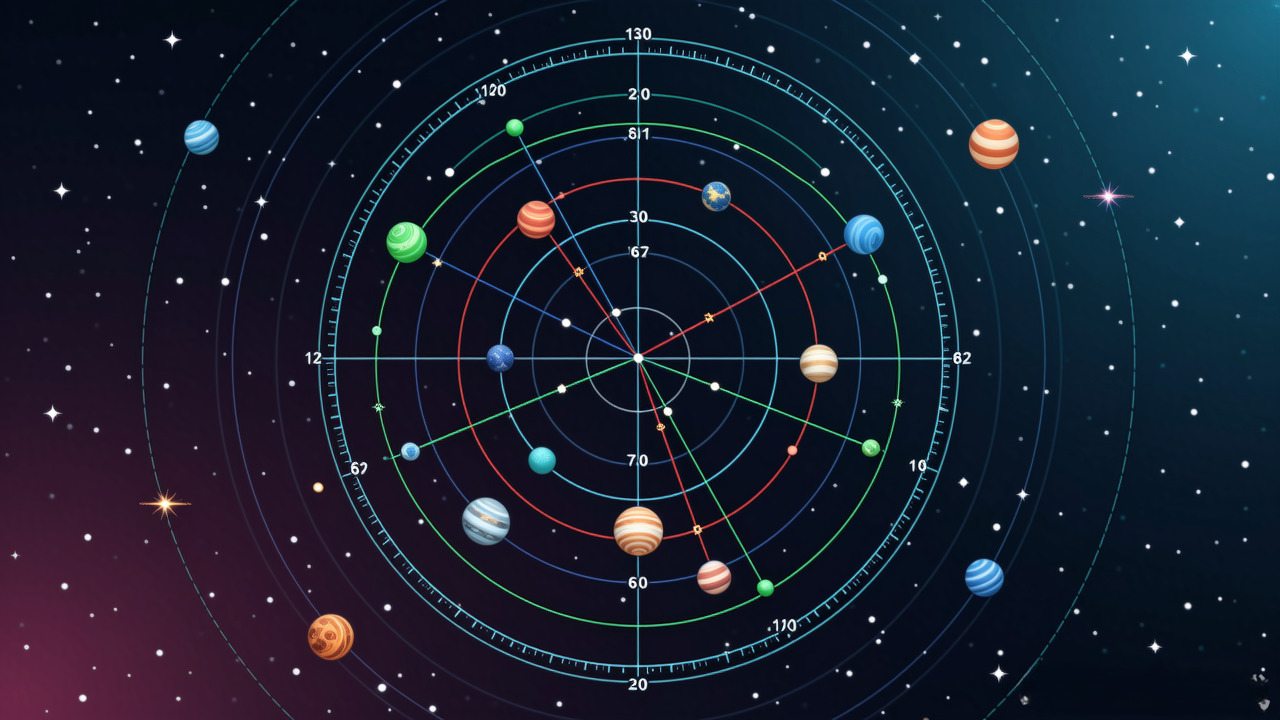
Planetary aspects form the backbone of astrological interpretation, revealing how different parts of your personality and life circumstances interact. When you look at your birth chart, you'll notice lines connecting planets—these represent the geometric relationships between celestial bodies, each telling a unique story about your inner dynamics.
What Are Planetary Aspects?
In traditional astrology, aspects are specific angular relationships between planets measured along the ecliptic—the apparent path of the Sun around Earth. These mathematical relationships create energetic channels through which planetary energies communicate, cooperate, or conflict.
The concept dates back to ancient Babylonian and Hellenistic astrology, where astronomers observed that certain angles produced noticeable effects. Claudius Ptolemy, in his 2nd-century work Tetrabiblos, systematized the major aspects we still use today: conjunction (0°), sextile (60°), square (90°), trine (120°), and opposition (180°).
Aspects aren't random connections—they represent the fundamental harmonic relationships found throughout nature. The same mathematical principles that govern musical intervals and planetary orbits appear in these celestial conversations.
Orb of Influence
No aspect is mathematically perfect in a birth chart. The allowable deviation from exactness is called the "orb." Traditional astrology uses tighter orbs than modern practice:
- Conjunctions and oppositions: 8-10° orb
- Squares and trines: 6-8° orb
- Sextiles: 4-6° orb
A planet at 10° Aries square another at 16° Cancer creates a 96° angle—close enough to the 90° square to be considered valid. The closer the aspect is to exact, the stronger its influence.
The Five Major Aspects
Conjunction (0°)
When two planets occupy the same zodiac degree, they form a conjunction—the most powerful aspect. Their energies blend completely, creating a unified force that can be either harmonious or challenging depending on the planets involved.
Traditional Interpretation: Conjunctions represent fusion and concentration. Medieval astrologers considered conjunctions with benefic planets (Venus, Jupiter) as fortunate, while conjunctions with malefic planets (Mars, Saturn) brought challenges.
Practical Example: A Sun-Moon conjunction creates someone with consistent self-expression—their inner needs and outer identity align seamlessly. However, if Mars conjoins Saturn, the individual might struggle with frustration meeting responsibilities or expressing anger appropriately.
Key Characteristics:
- Planets work as a single unit
- Intensity depends on planetary compatibility
- Creates strong focal points in the chart
Sextile (60°)
Sextiles occur between planets two signs apart, creating opportunities through complementary elements. Fire signs sextile Air signs, while Earth signs sextile Water signs.
Traditional Interpretation: Considered mildly beneficial, sextiles represent opportunities that require conscious effort to activate. Unlike trines, they don't flow automatically—you must recognize and utilize them.
Practical Example: Mercury in Gemini sextile Jupiter in Leo suggests natural talent for entertaining communication or teaching. The individual might excel at making complex topics engaging through storytelling.
Key Characteristics:
- Harmonious but requires activation
- Represents latent talents and opportunities
- Elements share the same modality (cardinal, fixed, or mutable)
Square (90°)
Squares create tension between planets three signs apart, always connecting signs of the same modality but different elements. These are the cardinal, fixed, and mutable squares.
Traditional Interpretation: Squares represent necessary challenges that drive growth. Medieval texts called them "the mother of accomplishment" because friction generates movement and development.
Practical Example: Venus in Taurus square Mars in Leo might indicate tension between comfort-seeking (Taurus) and dramatic self-expression (Leo). This person might overspend to feel luxurious or struggle balancing relationship needs with personal creativity.
Key Characteristics:
- Creates internal and external conflicts
- Drives action and development
- Often manifests as recurring life challenges
Trine (120°)
Trines connect planets four signs apart within the same element, creating effortless flow. Fire trines involve Aries, Leo, Sagittarius; Earth trines Taurus, Virgo, Capricorn; Air trines Gemini, Libra, Aquarius; Water trines Cancer, Scorpio, Pisces.
Traditional Interpretation: Considered the most fortunate aspect, trines represent innate talents and ease. However, traditional warnings note that too many trines can create complacency without sufficient challenging aspects.
Practical Example: Moon in Cancer trine Neptune in Pisces suggests exceptional emotional intuition and artistic sensitivity. The individual naturally understands subtle emotional currents and might excel in creative or healing professions.
Key Characteristics:
- Natural talents and ease
- Little internal resistance
- Can lead to taking abilities for granted
Opposition (180°)
Oppositions create awareness through polarity—planets directly across from each other, always in complementary signs (Aries-Libra, Taurus-Scorpio, etc.).
Traditional Interpretation: Oppositions represent relationships and externalization. They often manifest through other people or circumstances that mirror our internal conflicts.
Practical Example: Sun in Capricorn opposite Moon in Cancer creates tension between career ambition and domestic needs. This person might struggle balancing professional responsibilities with family life, often feeling pulled in both directions.
Key Characteristics:
- Heightens awareness through contrast
- Often involves other people
- Creates dynamic balance when integrated
Aspect Strength and Condition
Not all aspects operate with equal power. Several factors determine their strength:
Essential Dignity
Planets in their rulership or exaltation express their nature more purely. A square from a dignified planet carries different weight than one from a debilitated planet.
Example: Mars in Aries (rulership) square Saturn carries the energy of focused, direct action meeting obstacles. Mars in Cancer (fall) square Saturn suggests frustrated emotional reactions to limitations.
Accidental Dignity
A planet's house position and aspects from other planets modify its expression. A benefic planet in an angular house (1st, 4th, 7th, 10th) has stronger impact, while cadent house placement (3rd, 6th, 9th, 12th) weakens expression.
Applying vs. Separating
When a faster planet moves toward exact aspect with a slower planet, it's "applying"—the energy is building. After the exact aspect, it's "separating"—the energy is integrating. Applying aspects often feel more immediate and urgent.
Minor Aspects
While the five major aspects form the core of traditional interpretation, several minor aspects add nuance:
Quincunx (150°)
Also called inconjunct, this aspect creates adjustment needs between incompatible signs. It requires conscious effort to integrate disparate energies.
Example: Mercury in Aries quincunx Saturn in Virgo might indicate difficulty organizing spontaneous ideas into practical systems.
Semi-Sextile (30°)
A mild aspect suggesting gradual development through small adjustments between adjacent signs.
Semi-Square (45°) and Sesquiquadrate (135°)
Minor tension aspects that create irritations and minor frustrations that nevertheless require attention.
Aspect Patterns
When multiple aspects form geometric patterns, they create complex psychological dynamics that shape entire life themes.
Grand Trine
Three planets trine each other, forming an equilateral triangle within one element. This creates a natural talent area but can also indicate areas where effort is avoided.
Interpretation: A Grand Water Trine (Moon, Neptune, Pluto) suggests profound emotional depth and psychic sensitivity, but might indicate emotional avoidance or excessive privacy.
T-Square
Two planets in opposition, both squaring a third planet. This creates constant tension that demands resolution through the "empty leg"—the point opposite the focal planet.
Interpretation: A T-Square with Moon opposite Saturn, both square Venus suggests deep patterns around love, security, and self-worth that drive significant personal growth.
Grand Cross
Four planets forming two oppositions and four squares—a complex pattern of conflicting needs and pressures from all directions.
Interpretation: Requires developing exceptional balance and perspective to manage competing life areas simultaneously.
Interpreting Aspects in Practice
Step 1: Identify the Aspect Pattern
Start by looking for the strongest aspects in your chart—those with the tightest orbs. Note which planets are involved and what houses they rule.
Step 2: Consider Planetary Natures
A square between Venus and Jupiter operates differently than one between Mars and Saturn. The planets' essential meanings color the aspect's expression.
Step 3: Examine House Placement
A trine between 10th house Saturn and 2nd house Venus suggests natural talent for building valuable career assets, while the same trine between 12th and 4th houses might indicate spiritual inheritance or family secrets.
Step 4: Look for Aspect Patterns
Note any major configurations—these create overarching life themes that individual aspects serve.
Practical Application in Daily Life
Understanding your natal aspects helps you work with your natural energies rather than against them. Check your daily horoscope to see how current transits activate your natal aspects.
For challenging aspects (squares, oppositions):
- Recognize recurring patterns as growth opportunities
- Develop conscious strategies for managing tension
- Use the energy for constructive action
For flowing aspects (trines, sextiles):
- Identify and develop your natural talents
- Avoid taking abilities for granted
- Use ease to balance challenging areas
For conjunctions:
- Understand your core driving energies
- Recognize both strengths and potential imbalances
- Develop awareness of this concentrated power
Historical Context and Evolution
Traditional astrology placed greater emphasis on planetary condition and essential dignity than modern psychological astrology. Hellenistic astrologers like Vettius Valens considered the sect of the chart (day or night birth) crucial for interpreting aspects—a benefic planet supporting the sect light (Sun for day, Moon for night) carried greater benefit.
Medieval astrologers like William Lilly used aspects for precise timing events, while Renaissance astrologers incorporated planetary aspects into medical astrology and character analysis.
The modern psychological approach, pioneered by Carl Jung and astrologers like Dane Rudhyar, emphasizes aspects as internal dynamics rather than external events, though both perspectives hold value.
Common Aspect Interpretations
| Aspect Combination | Traditional Meaning | Modern Interpretation |
|---|---|---|
| Sun square Moon | Parental conflict | Internal tension between needs and identity |
| Venus trine Jupiter | Social and financial benefit | Natural generosity and relationship luck |
| Mars opposite Saturn | Obstacles and frustration | Discipline meeting resistance |
| Mercury conjunct Uranus | Sudden insights | Innovative, original thinking |
| Moon square Pluto | Emotional intensity | Deep psychological transformation |
Putting It All Together
Learning to interpret aspects is like understanding a complex conversation between different parts of yourself. Each aspect adds another layer of meaning, creating the rich tapestry of your individual character and life path.
The most effective approach combines traditional techniques with psychological insight. Remember that no aspect is inherently "good" or "bad"—challenging aspects often drive the most significant growth, while easy aspects can become underutilized potentials.
Start by examining the major aspects in your own chart, particularly those involving personal planets (Sun, Moon, Mercury, Venus, Mars). Notice how these patterns manifest in your daily life and relationships. With practice, you'll develop an intuitive understanding of how these celestial conversations shape your earthly experience.
As you continue your astrological studies, you'll discover that aspects don't operate in isolation—they form an interconnected web that reveals the unique mathematics of your soul's journey. Each geometric relationship contributes to the complex, beautiful, and utterly individual person you are becoming.
Ready to Explore Your Birth Chart?
Apply what you've learned by calculating your personalized birth chart with guided interpretation
Open Free Birth Chart