The Four Elements in Astrology: Understanding Fire, Earth, Air, and Water Signs
Discover how the four elements—Fire, Earth, Air, and Water—shape zodiac sign personalities and influence astrological compatibility in your birth chart.
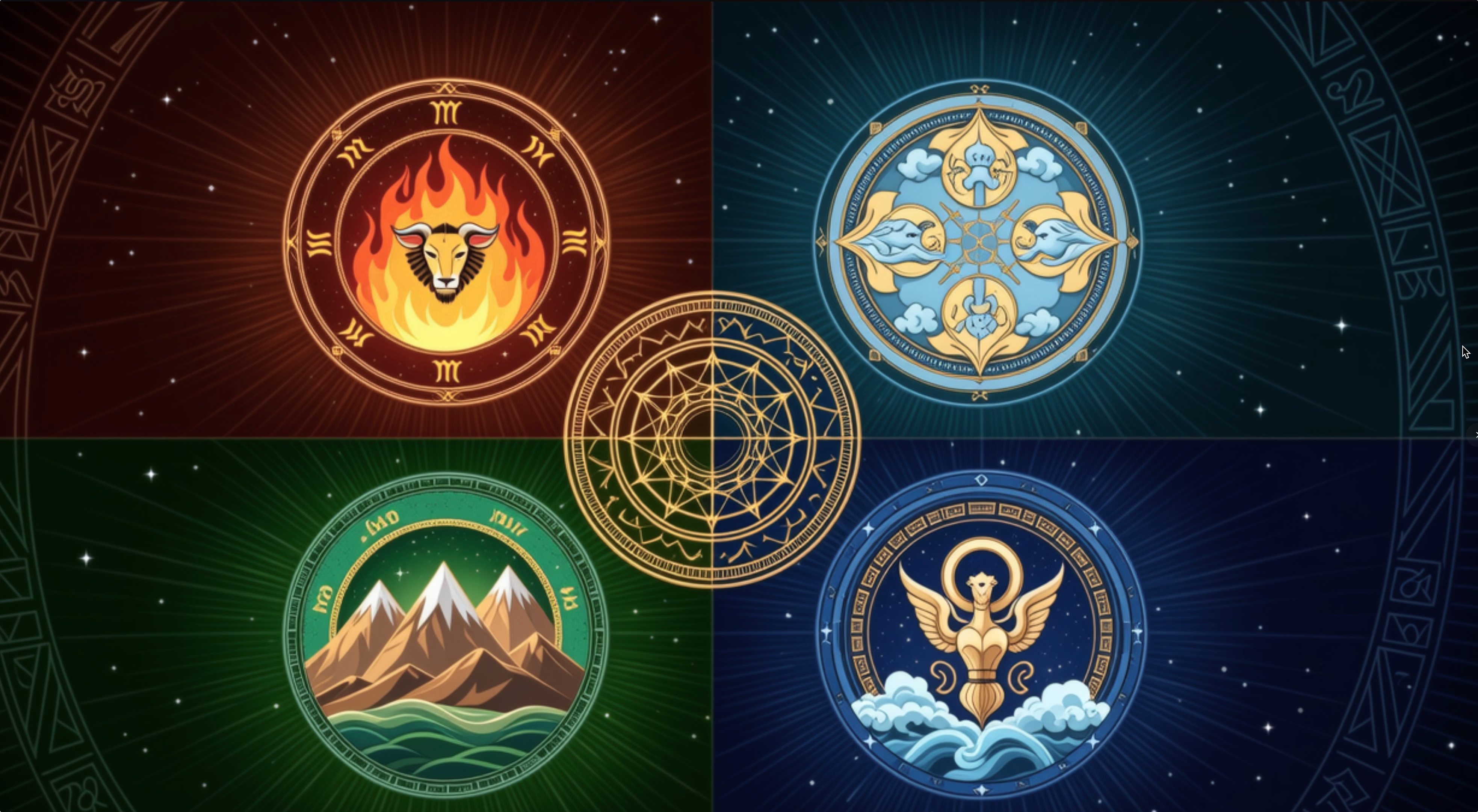
The four elements—Fire, Earth, Air, and Water—form the foundation of astrological understanding. This ancient system, dating back to Greek philosophy and earlier traditions, provides a framework for understanding human temperament, motivation, and behavior through the zodiac signs. Each element represents a fundamental mode of being that shapes how signs express themselves and interact with the world.
In traditional astrology, the elements correspond to the four basic states of matter recognized in ancient science: Fire (energy), Earth (solid), Air (gas), and Water (liquid). This classification system helps astrologers understand the essential nature of each zodiac sign and provides insight into compatibility, personal growth, and life purpose.
The Historical Foundation of Elemental Astrology
The concept of four elements predates modern astrology by millennia. Ancient Greek philosophers, particularly Empedocles and later Aristotle, formalized the four-element system that would become central to Western astrology. These elements were understood as the building blocks of the physical world, each possessing two of the four fundamental qualities: hot, cold, wet, and dry.
In medieval astrology, the elements became integrated with medical astrology through the concept of the four humors. Fire corresponded to choleric temperament, Earth to melancholic, Air to sanguine, and Water to phlegmatic. This system provided a comprehensive framework for understanding human psychology and physiology that remained influential for centuries.
The elements also appear in other ancient traditions. Chinese philosophy recognizes five elements (Wood, Fire, Earth, Metal, Water), while Hindu astrology uses three doshas (Vata, Pitta, Kapha) that share similarities with the Western elemental system. This cross-cultural recognition of elemental principles suggests they represent fundamental patterns in human experience.
Understanding the Elemental Qualities
Each element combines two of the four fundamental qualities recognized in traditional astrology:
Hot and Cold refer to the element's energetic state. Hot elements (Fire, Air) are expansive and active, while cold elements (Earth, Water) are contractive and receptive.
Wet and Dry describe the element's relationship to form. Wet elements (Air, Water) are adaptable and flexible, while dry elements (Fire, Earth) maintain fixed boundaries.
This combination creates the distinctive characteristics of each element:
| Element | Quality 1 | Quality 2 | Temperament | Mode of Expression |
|---|---|---|---|---|
| Fire | Hot | Dry | Choleric | Active, Projective |
| Earth | Cold | Dry | Melancholic | Passive, Structural |
| Air | Hot | Wet | Sanguine | Active, Interactive |
| Water | Cold | Wet | Phlegmatic | Passive, Receptive |
Understanding these qualities helps explain why certain elements naturally complement or conflict with others. For instance, Fire and Air share the hot quality, making them naturally compatible, while Fire and Water oppose each other in both temperature and moisture.
The Fire Signs: Aries, Leo, Sagittarius
Fire represents spirit, energy, inspiration, and the life force itself. In traditional astrology, Fire is associated with the vital principle that animates all living things. Fire signs are characterized by their enthusiasm, courage, and desire to make their mark on the world.
Core Characteristics of Fire Energy
Fire energy is radiant, warm, and self-expressive. People with strong Fire placements in their birth chart tend to be motivated by vision, inspiration, and the desire for significance. They're natural leaders who thrive on challenge and recognition.
The three Fire signs express this energy differently:
- Aries (Cardinal Fire): Initiating energy, pioneering spirit, competitive drive
- Leo (Fixed Fire): Sustaining energy, creative expression, loyalty
- Sagittarius (Mutable Fire): Expansive energy, philosophical seeking, adventure
Fire in Action: Practical Examples
Consider how Fire energy manifests in daily life:
- An Aries entrepreneur starts a new business based on a visionary idea
- A Leo performer commands the stage with confidence and charisma
- A Sagittarius teacher inspires students with expansive philosophical concepts
Fire-dominated individuals often struggle with patience and practical details. They may become frustrated when their grand visions meet resistance or require tedious implementation. Their challenge is to balance inspiration with practical action.
Balancing Fire Energy
When Fire is overemphasized in a chart, people may become impulsive, dramatic, or self-centered. They benefit from grounding practices, patience, and developing empathy for others' perspectives. Earth energy can help temper Fire's excesses by providing stability and practical consideration.
The Earth Signs: Taurus, Virgo, Capricorn
Earth represents the material world, physical reality, and practical manifestation. In traditional astrology, Earth is associated with the body, resources, and tangible results. Earth signs are characterized by their reliability, sensuality, and connection to the physical realm.
Core Characteristics of Earth Energy
Earth energy is solid, stable, and grounded. People with strong Earth placements value security, competence, and tangible achievement. They're the builders and sustainers of the zodiac, excellent at turning ideas into reality.
The three Earth signs express this energy differently:
- Taurus (Fixed Earth): Stabilizing energy, sensory appreciation, material security
- Virgo (Mutable Earth): Adaptable energy, practical service, analytical refinement
- Capricorn (Cardinal Earth): Initiating energy, structural achievement, long-term goals
Earth in Action: Practical Examples
Earth energy manifests through practical accomplishment:
- A Taurus gardener creates beauty through patient cultivation
- A Virgo accountant organizes complex financial systems with precision
- A Capricorn executive builds a sustainable business structure
Earth-dominated individuals may struggle with change, abstraction, or emotional expression. They can become overly focused on security or critical of imperfections. Their challenge is to remain open to new possibilities while maintaining their practical foundation.
Balancing Earth Energy
When Earth is overemphasized, people may become rigid, materialistic, or resistant to change. They benefit from incorporating Air's mental flexibility and Fire's inspirational energy. Learning to value process over product and embracing uncertainty can help Earth signs grow.
The Air Signs: Gemini, Libra, Aquarius
Air represents intellect, communication, and social connection. In traditional astrology, Air is associated with the mind, ideas, and the realm of thought. Air signs are characterized by their curiosity, objectivity, and desire for mental stimulation.
Core Characteristics of Air Energy
Air energy is light, mobile, and connecting. People with strong Air placements thrive on information exchange, social interaction, and conceptual understanding. They're natural communicators who see patterns and relationships others might miss.
The three Air signs express this energy differently:
- Gemini (Mutable Air): Adaptable energy, information gathering, verbal expression
- Libra (Cardinal Air): Initiating energy, social harmony, aesthetic judgment
- Aquarius (Fixed Air): Sustaining energy, innovative ideas, collective vision
Air in Action: Practical Examples
Air energy manifests through mental and social activity:
- A Gemini journalist connects diverse ideas into coherent stories
- A Libra mediator finds balanced solutions to complex conflicts
- An Aquarius inventor develops technology that serves community needs
Air-dominated individuals may struggle with emotional depth, practical application, or commitment to concrete action. They can become detached, indecisive, or overly theoretical. Their challenge is to ground their ideas in practical reality and develop emotional intelligence.
Balancing Air Energy
When Air is overemphasized, people may become ungrounded, emotionally disconnected, or scattered. They benefit from Earth's practical focus and Water's emotional depth. Practices that connect them with their bodies and feelings can help Air signs achieve greater integration.
The Water Signs: Cancer, Scorpio, Pisces
Water represents emotion, intuition, and the unconscious. In traditional astrology, Water is associated with the soul, feelings, and deep psychological patterns. Water signs are characterized by their sensitivity, empathy, and connection to the invisible realms.
Core Characteristics of Water Energy
Water energy is fluid, deep, and receptive. People with strong Water placements experience life through feeling, intuition, and emotional resonance. They're naturally empathetic and often serve as emotional containers for others.
The three Water signs express this energy differently:
- Cancer (Cardinal Water): Initiating energy, emotional security, nurturing protection
- Scorpio (Fixed Water): Sustaining energy, emotional depth, transformative power
- Pisces (Mutable Water): Adaptable energy, spiritual connection, universal compassion
Water in Action: Practical Examples
Water energy manifests through emotional and intuitive processes:
- A Cancer parent creates a safe emotional environment for their family
- A Scorpio therapist facilitates deep psychological healing
- A Pisces artist channels universal emotions into creative expression
Water-dominated individuals may struggle with boundaries, objectivity, or practical concerns. They can become overwhelmed by emotions, manipulative, or escapist. Their challenge is to maintain emotional connection while developing healthy detachment.
Balancing Water Energy
When Water is overemphasized, people may become emotionally overwhelmed, codependent, or boundary-less. They benefit from Air's mental clarity and Fire's assertive energy. Developing discernment and learning to channel emotions creatively can help Water signs maintain equilibrium.
Elemental Balance in Your Birth Chart
Understanding the distribution of elements in your personal birth chart provides profound insight into your natural strengths, challenges, and developmental path. Most people have a mix of elements, with one or two typically dominant.
Calculating Your Elemental Distribution
To assess your elemental balance:
- Note the element of each planet's zodiac sign placement
- Consider the Ascendant and Midheaven signs
- Pay special attention to personal planets (Sun, Moon, Mercury, Venus, Mars)
- Notice any elements that are completely missing
A balanced chart typically has representation from three or four elements, though many people have one or two emphasized elements with others underrepresented.
Interpreting Elemental Emphasis
Fire Emphasis: Strong motivation, inspiration, and self-expression. May need to develop patience and practical skills.
Earth Emphasis: Strong practicality, reliability, and material competence. May need to develop flexibility and vision.
Air Emphasis: Strong intellect, communication, and social ability. May need to develop emotional depth and practical application.
Water Emphasis: Strong intuition, empathy, and emotional intelligence. May need to develop boundaries and objectivity.
Missing Elements
When an element is completely absent from your chart, you may struggle with the qualities it represents. For example:
| Missing Element | Common Challenges | Development Strategies |
|---|---|---|
| Fire | Lack of motivation, low confidence | Set inspiring goals, take risks, practice self-assertion |
| Earth | Disorganization, impracticality | Create routines, develop skills, focus on tangible results |
| Air | Poor communication, lack of perspective | Study, socialize, practice objective analysis |
| Water | Emotional detachment, poor intuition | Practice self-reflection, develop empathy, explore creative expression |
Missing elements often represent your soul's learning agenda in this lifetime. By consciously developing these qualities, you achieve greater wholeness and effectiveness.
Elemental Compatibility and Relationships
The elements provide a useful framework for understanding relationship dynamics. While any combination can work with awareness and effort, some elemental pairings have natural affinity while others require more conscious adjustment.
Naturally Harmonious Combinations
Fire and Air support each other's expression. Air fuels Fire's inspiration with ideas, while Fire gives Air's concepts energy and direction.
Earth and Water nourish each other's needs. Water provides emotional support for Earth's practical efforts, while Earth offers stability for Water's sensitivity.
Challenging Combinations
Fire and Water can create steam or evaporation. Fire may feel Water is dampening its enthusiasm, while Water may feel burned by Fire's intensity.
Earth and Air may struggle to connect. Earth finds Air impractical and ungrounded, while Air finds Earth limiting and boring.
Balanced Relationships
The most sustainable relationships often involve complementary elements that share one quality. For instance, Fire and Earth share dryness, which can provide common ground for their different approaches.
Practical Applications of Elemental Astrology
Understanding the elements isn't just theoretical—it has practical applications for daily life, personal growth, and understanding your daily horoscopes more deeply.
Personal Development
Use your elemental understanding to:
- Identify natural strengths to leverage
- Recognize developmental areas needing attention
- Choose career paths that align with your elemental nature
- Develop balanced approaches to challenges
Relationship Understanding
Apply elemental knowledge to:
- Appreciate different communication styles
- Navigate conflicts with greater understanding
- Support partners in their growth areas
- Build complementary team dynamics
Timing and Decision Making
Consider elemental influences when:
- Planning important initiatives (align with supportive elements)
- Understanding emotional cycles (Water transits)
- Making practical decisions (Earth transits)
- Launching new projects (Fire transits)
- Communicating important ideas (Air transits)
Working with Elemental Imbalances
Most people have some elemental imbalance in their charts. Rather than seeing this as a problem, view it as your unique curriculum for this lifetime.
Strengthening Underrepresented Elements
If you lack a particular element:
- Missing Fire: Take up a physical practice, set challenging goals, practice speaking up
- Missing Earth: Develop routines, learn a hands-on skill, focus on completing projects
- Missing Air: Read widely, practice writing, engage in discussions, learn to debate
- Missing Water: Keep a journal, practice meditation, explore creative arts, develop empathy
Moderating Overrepresented Elements
If you have too much of one element:
- Excess Fire: Practice listening, develop patience, consider consequences before acting
- Excess Earth: Embrace change, try new approaches, value process over product
- Excess Air: Ground ideas in action, develop emotional intelligence, practice mindfulness
- Excess Water: Set healthy boundaries, develop objectivity, channel emotions creatively
The Elements Through the Houses
The elements interact with the houses in your birth chart to show where different types of energy manifest most strongly in your life.
Fire Houses (1st, 5th, 9th): Where you express identity, creativity, and philosophy Earth Houses (2nd, 6th, 10th): Where you build security, develop skills, and achieve recognition Air Houses (3rd, 7th, 11th): Where you communicate, relate, and participate in community Water Houses (4th, 8th, 12th): Where you experience emotions, intimacy, and spiritual connection
When a house's natural element aligns with the signs actually occupying that house in your chart, those life areas tend to flow more naturally. Mismatches may indicate areas requiring conscious development.
Conclusion: Living in Elemental Balance
The four elements provide a timeless framework for understanding human nature and our place in the cosmos. By recognizing the elemental patterns in your birth chart and daily experience, you gain practical wisdom for living more consciously and effectively.
Remember that elemental balance isn't about having equal amounts of each element, but about developing awareness of how all four modes of being operate within you. Each element offers essential gifts: Fire's inspiration, Earth's stability, Air's perspective, and Water's depth. By honoring all four, we move toward greater wholeness.
The elements remind us that we're part of nature's intelligent design, connected to the same fundamental forces that shape the world around us. As you continue your astrological studies, let this elemental understanding provide a solid foundation for deeper exploration of your birth chart and its unique configuration of energies.
Ready to Explore Your Birth Chart?
Apply what you've learned by calculating your personalized birth chart with guided interpretation
Open Free Birth Chart